Medical Simulation Training in VR: What Works, What Doesn't, and What It Costs to Scale
VR medical simulation vs. traditional labs: comparing surgical training and procedural rehearsal, plus steps to scale effectively.
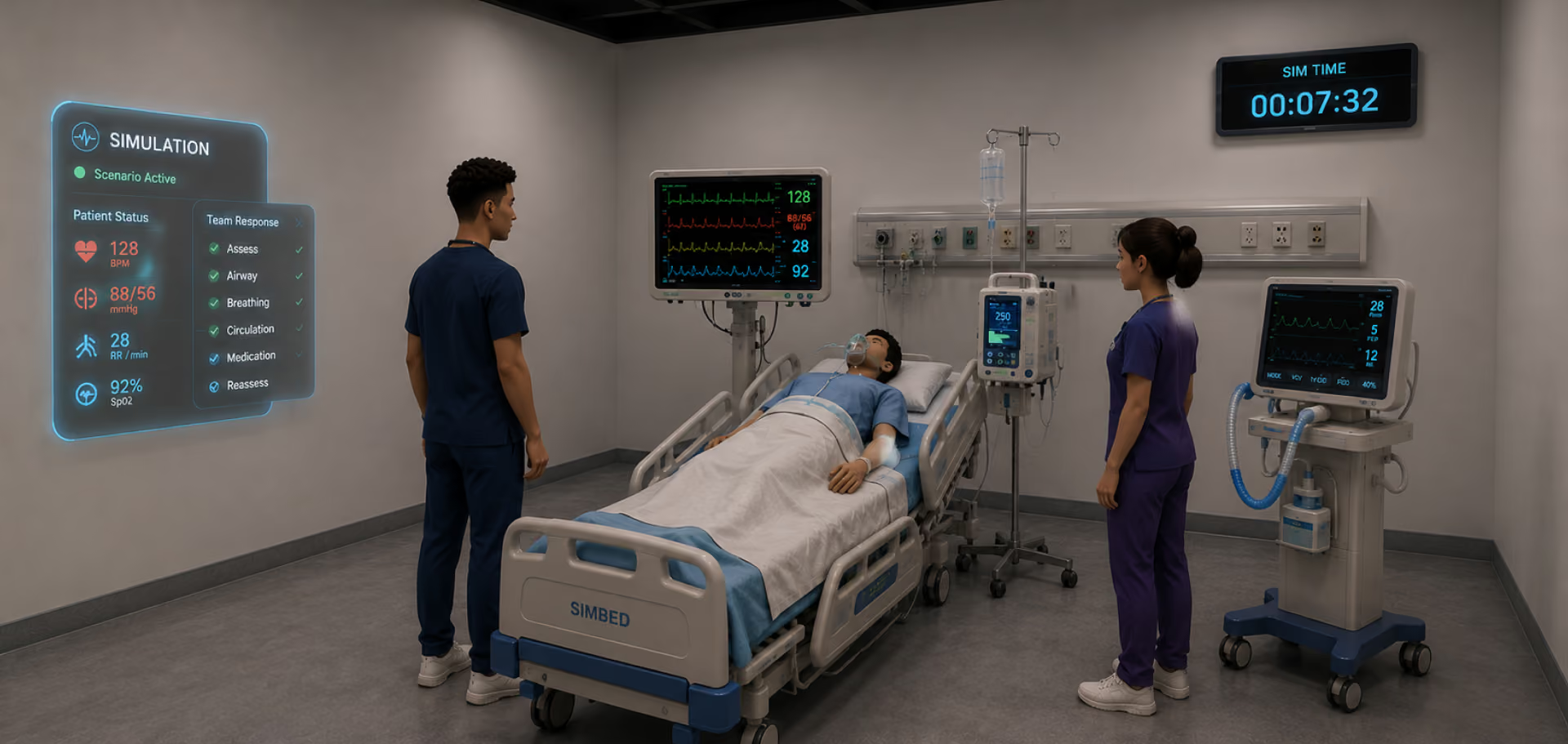
Every simulation center director knows the real constraint isn't whether simulation works. It's throughput.
You have one sim lab, a handful of high-fidelity mannequins, a booking calendar that's full six weeks out, and a cohort that needs more reps than the calendar can hold. Meanwhile the evidence for deliberate practice keeps saying the same thing: repetition is the variable that matters most, and repetition is exactly what the physical lab can't give you.
This is the gap VR medical simulation fills — when it's scoped honestly.
What is medical simulation training?
Medical simulation training is clinical practice in a controlled environment that imitates real patient care, allowing learners to rehearse procedures, decisions, and teamwork without patient risk. It spans low-fidelity task trainers, high-fidelity mannequins, standardized patients, and — increasingly — virtual reality environments where the entire clinical scene is simulated in 3D.
VR simulation isn't a replacement for the sim lab. It's a different point on the fidelity-versus-repetition curve, and understanding that curve is the whole game.
The fidelity-versus-repetition tradeoff
Every simulation modality trades one against the other:
- High-fidelity mannequins give you physical realism — palpable pulses, chest rise, real equipment, real hands. They also cost six figures, require technician support, occupy a physical room, and can serve one team at a time.
- VR simulation gives you unlimited repetition, zero scheduling friction, and consistent scenarios across every learner and every site. What it doesn't give you, on consumer-grade hardware, is convincing tactile feedback.
The mistake programs make is treating these as competing purchases. They're sequential. VR handles the cognitive and procedural layer — sequence, decision points, recognition, team communication — until the learner arrives at the physical lab already fluent in everything except the feel. The scarce resource (lab time) stops being spent teaching things that didn't require a mannequin.
VR surgical training: the strongest case and its honest limits
VR surgical training is the most-cited application of medical VR simulation, and the evidence base is the deepest here — particularly for laparoscopic and endoscopic procedures, where the surgeon is already operating through a screen and instruments rather than direct touch. When the real procedure is mediated by a monitor, the simulation gap narrows considerably.
Where VR surgical training performs well:
- Procedural sequence and instrument selection - the order of operations, rehearsed until automatic
- Anatomical orientation - spatial relationships at true scale, from angles a textbook can't show
- Rare-case exposure - complications a resident might see twice in training, rehearsed twenty times
- Pre-operative rehearsal - walking a specific patient's anatomy before the actual case
Where it doesn't:
- Tissue handling and force feedback - the tactile layer that separates competence from mastery still requires physical practice
- Assessment as a sole credentialing mechanism - VR performance data informs assessment; it doesn't replace supervised evaluation
Any vendor telling you VR replaces the OR or the cadaver lab is selling past the evidence, and your surgical faculty will notice immediately.
Beyond surgery: where most programs actually get value
Surgical simulation gets the headlines. Most deployed value sits elsewhere, in scenarios where the skill being trained is decision-making under conditions rather than manual technique.
- Emergency and code response - Rapid deterioration scenarios where the learning objective is recognition speed and protocol adherence. Runs unlimited times, no lab booking.
- Team-based crisis resource management - Multi-user environments where a distributed team — nurses, physicians, respiratory, pharmacy — works a scenario together as avatars, from different physical locations. Communication breakdown is the thing being trained, and it's fully observable.
- Equipment and device familiarization - New infusion pump, new ventilator, new device rollout across a system. Every clinician trains on a true-scale interactive model before the equipment arrives on the unit.
- Environment and workflow orientation - New graduate nurses walk the unit, locate the crash cart, and rehearse the workflow before their first shift — turning orientation hours into preparation.
- Patient communication and difficult conversations - Breaking bad news, informed consent, de-escalation — practiced with AI-driven conversational counterparts that respond in real time, without the scheduling cost of standardized patients.
The scaling problem nobody scopes for
Here's the pattern that kills VR simulation programs: the pilot runs on ten headsets in the sim center. It works. Then the ask becomes system-wide, and the arithmetic changes completely.
Headsets need purchasing, distribution, charging, sanitizing between users, IT support, and replacement. Clinical staff who wear glasses, experience motion sensitivity, or have accessibility constraints get excluded. The sim center — the one place with a headset workflow — becomes the bottleneck all over again, which is the exact problem VR was bought to solve.
Browser-based simulation removes the bottleneck. Scenarios run on the workstations, laptops, and tablets clinicians already use. Assignment is a link. Headsets stay available in the sim center for the cases that genuinely benefit from full immersion — but they're no longer the entry requirement.
The test question for any vendor: what does this look like for a nurse on a med-surg floor at 2am with no headset? If the answer is "they wait for a sim center slot," you've bought the old constraint in a new format.
Build versus buy: the content question
Off-the-shelf simulation libraries are fast to deploy and generic by definition. They don't contain your equipment, your protocols, your unit layout, or your patient population.
The programs that sustain past year one build their own scenarios — which is feasible only if building doesn't require a development studio. With XR Creator Studio, clinical educators construct scenarios visually: import your actual equipment models (GLB, GLTF, and OBJ import directly, including imaging-derived and AI-generated assets), place interactive elements, script decision branches without code, and add AI Agent characters as patients or team members. Scenarios publish as Verses reachable by link, QR, or numeric code.
The practical consequence: when your protocol changes, your educator updates the scenario that afternoon. They don't file a change request and wait six weeks for a vendor quote.
Common questions
- What is medical VR simulation? Medical VR simulation is clinical training delivered inside interactive 3D environments, where learners perform procedures, respond to patient scenarios, and make decisions in a simulated setting. It complements physical simulation by providing unlimited repetition without lab scheduling or consumable costs.
- Is VR surgical training effective? The evidence is strongest for procedures already performed through a screen, such as laparoscopic and endoscopic surgery, where VR effectively trains procedural sequence, anatomical orientation, and rare-complication response. It does not replace physical practice for tissue handling, where tactile feedback is the skill.
- How does VR simulation compare to mannequin-based simulation? Mannequins provide physical fidelity but limited throughput — one team, one room, one booking. VR provides unlimited repetition and consistency across sites but limited tactile realism. Most effective programs use VR for cognitive and procedural rehearsal, reserving scarce lab time for the hands-on layer.
- Do learners need VR headsets for medical simulation? Not on browser-based platforms. Scenarios run in a standard web browser on desktop, laptop, tablet, or mobile, with headsets optional. This is what makes system-wide deployment financially viable rather than limiting simulation to whoever can book the sim center.
- Can we build our own simulation scenarios? Yes. XR Creator Studio is a no-code visual editor — clinical educators import 3D models and build interactions without developers. Custom builds are available through NRD's XR Agency when a scenario needs bespoke development.
- What data does a VR simulation program produce? XRHUB Analytics reports active users, session duration, engagement time, and interaction events per environment — the completion and participation data programs need for reporting, without a separate evaluation project.
Related reading
See how this works on our virtual reality medical training platform page. You may also like VR in Nursing Education: A Practical Guide for Programs Facing a Placement Shortage and Virtual Reality in Healthcare: Applications, Benefits, and What Actually Deploys.
A reasonable first step
Pick the scenario your sim calendar can't accommodate. Not the most impressive one — the one with a waitlist. That's where the throughput math is already proven, and where a browser-based version pays for itself before anyone debates fidelity.
Get a demo, and we'll build that scenario in the conversation, or Build for Free and try the editor yourself.