What Is Metaverse as a Service (MaaS)?
Metaverse as a Service (MaaS) lets enterprises run branded 3D spaces without infrastructure. Here’s what’s actually included.
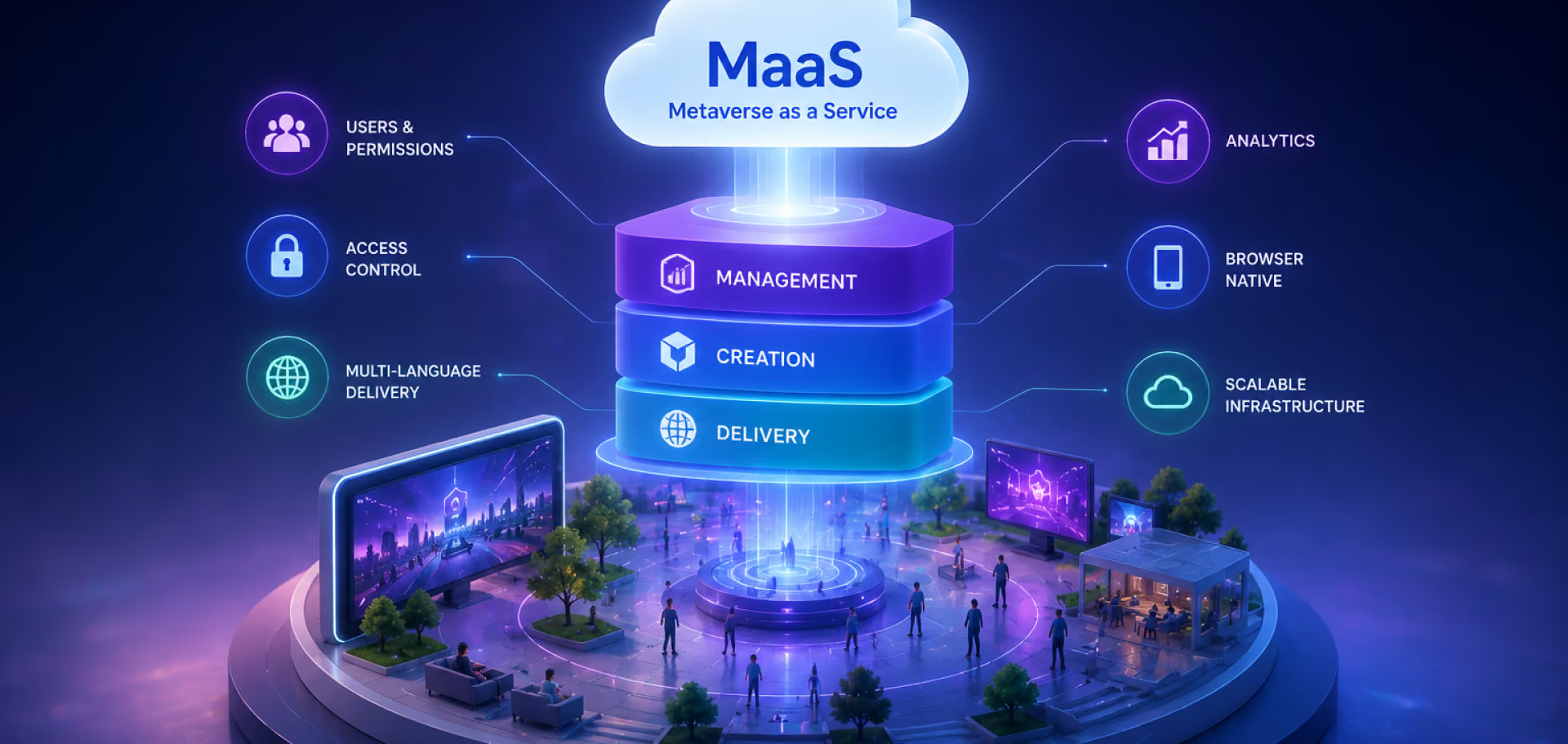
Metaverse as a Service (MaaS) is a subscription model where an enterprise builds, publishes, and manages branded 3D environments on infrastructure it doesn't have to own or maintain — the platform vendor handles hosting, rendering, multi-user infrastructure, and updates, while the enterprise focuses on content and use case.
It's the same shift SaaS made two decades ago, applied to spatial computing: instead of standing up 3D infrastructure and a dev team, an organization rents the capability and builds on top of it.
What's included in a MaaS platform
A complete MaaS offering typically covers three layers:
- Management — a dashboard for organizing environments, users, and permissions across the organization (this is what NRD calls XRHUB)
- Creation — a no-code visual editor for building environments, importing 3D models, and adding interactivity without developers (XR Creator Studio)
- Delivery — the runtime layer that actually hosts and serves the finished experience to end users at a live URL, on any browser (Verses)
Analytics, multi-language delivery, and access control (public vs. private environments) sit across all three layers rather than being a separate add-on.
Why enterprises are moving to MaaS instead of custom builds
Custom-built 3D infrastructure requires specialized engineering talent, ongoing hosting and rendering cost, and a maintenance burden that scales with every new environment. MaaS collapses that into a subscription: the same team that would have needed developers to publish one custom environment can, on a platform, publish many — because the underlying infrastructure is already built and maintained by the vendor.
Common questions about Metaverse as a Service
- What is Metaverse as a Service (MaaS)? Metaverse as a Service is a subscription-based platform model that provides the infrastructure, tools, and hosting needed to build and run branded 3D virtual environments — so enterprises don't need to build 3D rendering, hosting, or multi-user infrastructure themselves.
- How is MaaS different from building a custom metaverse platform? A custom build means hiring engineers to build rendering, hosting, and multi-user infrastructure from scratch — a multi-month, capital-intensive undertaking. MaaS provides that infrastructure already built, so teams focus on content and use case instead of platform engineering.
- Do users need VR headsets to access a MaaS environment? No, on browser-native MaaS platforms. Environments run on standard web browsers across desktop, mobile, and tablet, with VR headset support available as an optional immersion layer rather than a requirement for access.
- Who typically manages a MaaS platform inside an enterprise? It varies by use case — L&D teams for training environments, marketing for brand activations, events teams for virtual conferences, and R&D for design review. The no-code nature of most MaaS platforms means the owner is usually the business function using it, not IT.
- What should I look for when evaluating a MaaS vendor? Check for no-code environment building, native 3D model import (GLB/GLTF/OBJ), built-in analytics, multi-language delivery, and whether environments are truly browser-native rather than requiring app downloads or headsets — that last point determines how big your actual reachable audience is.
Related reading
See how this works on our Next Reality Digital XR Agency page. You may also like What Does an XR Agency Do?, No-Code XR: How XR Creator Studio Lets Anyone Build 3D Experiences, and our guide on how to choose between an XR agency and an in-house XR team.
Get started
See the platform in action. Get a Demo or Build for Free