Virtual Reality in Healthcare: Applications, Benefits, and What Actually Deploys
How VR is used in healthcare—training, simulation, and patient education—plus its real benefits, limitations, and scalability.
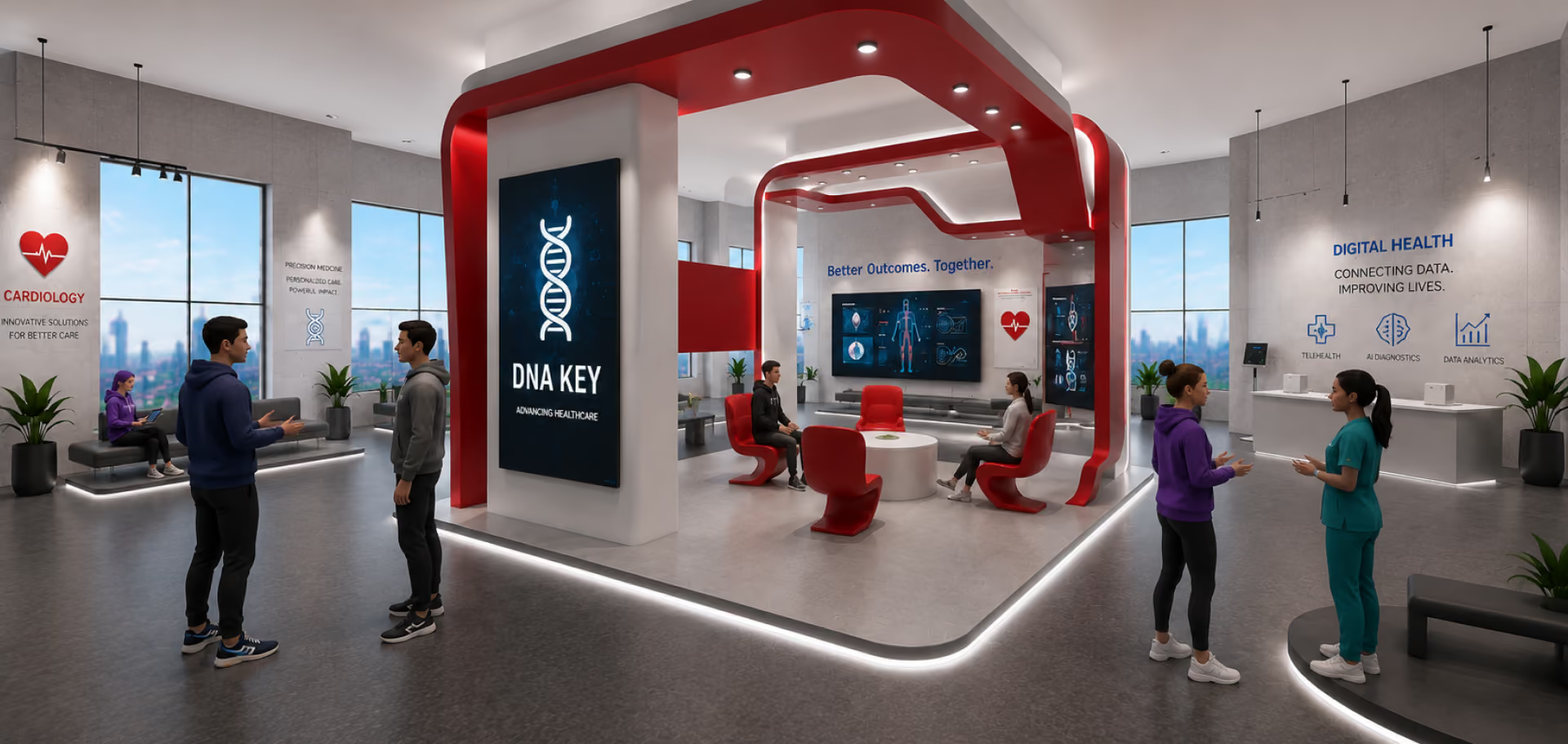
Virtual reality in healthcare has been three years away for about fifteen years. Every cycle produces a wave of pilots, a wave of conference talks, and a smaller wave of programs that quietly get decommissioned when the headsets stop being charged.
That pattern is finally breaking — not because the headsets got better, but because the best healthcare XR programs stopped requiring them.
This is a practical guide to how virtual reality is actually used in healthcare today, what the benefits are when you strip out the marketing, and what separates programs that scale from pilots that stall.
What is virtual reality in healthcare?
Virtual reality in healthcare is the use of immersive 3D environments for clinical training, medical education, patient communication, and professional events. Clinicians and learners enter a simulated environment — an operating room, a patient bedside, a lecture hall — and practice, learn, or collaborate inside it rather than reading about it or watching a video.
The term covers a spectrum. Virtual reality (VR) replaces the environment entirely. Augmented reality (AR) overlays information on the real world. Mixed reality (MR) anchors virtual objects into physical space. Collectively these are extended reality (XR) — and in enterprise healthcare, XR is the more useful word, because most real programs mix modes depending on the use case and the device the learner has in hand.
The six applications that actually get funded
Across healthcare systems, medical schools, and life sciences companies, six use cases account for the overwhelming majority of deployed XR programs.
- Clinical and procedural training. Learners rehearse procedures in a simulated environment where mistakes cost nothing and repetition is unlimited. This is the highest-value application because the alternative — cadaver labs, simulation centers, supervised patient contact — is scarce and expensive.
- Continuing medical education (CME). Immersive CME sessions replace slide decks with environments learners move through. Attendance and engagement data comes out of the platform automatically, which matters for documentation.
- Virtual medical conferences. Multi-track events with keynote stages, poster halls, and networking spaces, joined from anywhere. Post-pandemic, the demand didn't disappear — it shifted to hybrid.
- Patient education. Showing a patient their procedure in 3D before consent does more for comprehension than a pamphlet. Anxiety reduction is a documented secondary benefit.
- Medical device and pharma experiences. Device manufacturers demonstrate equipment at true scale without shipping units to every conference booth and sales meeting.
- Onboarding and facility familiarization. New clinical staff walk the unit, find the equipment, and learn the workflow before their first shift.
The benefits of VR in healthcare, honestly assessed
The benefits are real. They are also routinely overstated in ways that hurt buyers when the program hits procurement.
What holds up:
- Repetition at near-zero marginal cost. The tenth run of a simulation costs the same as the first. No consumables, no lab time, no scheduling.
- Safe failure. Learners can make the wrong call and see the consequence — the single hardest thing to provide in live clinical education.
- Spatial understanding. Anatomy, equipment layout, and procedural sequences are spatial problems. A 2D screen flattens them; a 3D environment doesn't.
- Consistency across sites. Every learner gets the same scenario, whether they're in Miami, Bogotá, or São Paulo. Instructor variability disappears.
- Measurable engagement. Session duration, completion, and interaction data come out of the platform as a byproduct, not as a separate evaluation project.
What to be skeptical about:
- Retention statistics quoted without a source. Vendors circulate impressive percentage claims with no citation. Ask for the study. Ask about the sample size and the comparison condition.
- "Replaces" claims. XR supplements cadaver labs, simulation centers, and supervised practice. It doesn't replace them, and any vendor claiming otherwise is setting you up for a credibility problem with your clinical educators.
- Haptic fidelity. Tactile realism in consumer-grade hardware is still limited. For procedures where feel is the skill, VR trains the sequence and the decision-making, not the hands.
Where augmented reality fits differently
Augmented reality in healthcare solves a different problem than VR: it keeps the clinician in the real environment and adds information to it. The clearest applications are intraoperative guidance, vein visualization, and equipment maintenance overlays — situations where the practitioner must stay physically present and needs data layered on top of what they're already doing.
For training and education — the bulk of what healthcare organizations actually buy — VR and browser-based 3D environments carry more weight, because the learning benefit comes from being somewhere else entirely.
Why most healthcare VR programs stall
The pattern is consistent enough to be predictable. A department runs a pilot with ten headsets. The pilot succeeds. Someone asks how it scales to 3,000 clinical staff across six facilities — and the program dies in that meeting.
Headset-dependent programs carry costs that never appear in the pilot: procurement, distribution, sanitization between users, charging infrastructure, IT support for a device class most hospital IT teams have no process for, breakage, and loss. Add the clinicians who can't use a headset — glasses, motion sensitivity, accessibility constraints — and a "mandatory" VR program quietly becomes an optional one.
None of this is an argument against immersive learning. It's an argument against making the headset the entry requirement.
The browser-native shift
The healthcare XR programs scaling in 2026 deliver immersive environments through the web browser on devices clinicians already carry. A learner clicks a link on a workstation, laptop, tablet, or phone and is inside the environment. Headsets remain supported for teams that want deeper immersion — but they're an upgrade path, not a gate.
The practical difference: a browser-native program can be assigned to every clinician in the system on day one. A headset program can be assigned to whoever has a headset.
This is the architecture behind NRD's platform. Environments are built in XR Creator Studio, a no-code 3D editor that accepts GLB, GLTF, and OBJ models — so existing anatomical models, device exports, and imaging-derived assets import directly. They're published as Verses that learners reach by link, QR code, or numeric code. XRHUB reports attendance, session duration, and engagement per environment. Delivery runs in English, Spanish, and Portuguese from the same build.
How to scope a program that survives procurement
Three questions, asked before the pilot rather than after:
- Will the pilot run on the same platform production will? If the pilot is a custom build and production requires the vendor for every content change, you piloted a prototype, not a platform.
- Does the pilot capture the metrics finance will judge it on? Completion rates, time-to-competency, cost per trained clinician. A satisfaction survey doesn't fund a renewal.
- Does the pilot include the constraints production will face? Device diversity, languages, IT and security review, accessibility. Every constraint deferred to production becomes a delay in production.
Common questions
- How is virtual reality used in healthcare? Virtual reality is used in healthcare for clinical and procedural training, continuing medical education, medical simulation, patient education, virtual conferences, and medical device demonstrations. Learners enter a 3D environment and practice or learn inside it rather than through slides or video.
- What are the benefits of VR in healthcare? The main benefits are unlimited repetition at near-zero marginal cost, safe failure without patient risk, better spatial understanding of anatomy and procedures, consistent training across sites, and automatic engagement measurement. Benefits scale only when access isn't limited by hardware.
- Do clinicians need a VR headset? Not on browser-native platforms. Environments run in a standard web browser on desktop, tablet, or mobile, with headsets supported as an option. This is the difference between a departmental pilot and a system-wide program.
- What is the difference between VR, AR, and XR in healthcare? VR replaces the environment entirely, AR overlays information onto the real world, and MR anchors virtual objects in physical space. XR — extended reality — is the umbrella term covering all three, and it's the more accurate word for most enterprise healthcare programs.
- Can we use our own 3D models? Yes. XR Creator Studio imports GLB, GLTF, and OBJ files, plus images, video, audio, and PDFs — so anatomical models, device exports, and existing educational media go in directly, with no proprietary conversion step.
Related reading
See how this works on our virtual reality medical training platform page. You may also like Medical Simulation Training in VR: What Works, What Doesn't, and What It Costs to Scale and VR in Nursing Education: A Practical Guide for Programs Facing a Placement Shortage.
Where to start
The organizations getting value from XR in healthcare didn't start with a hardware purchase. They started with one use case that was already expensive to deliver — a procedure with limited lab time, a CME program with a venue ceiling, an onboarding process that consumed preceptor hours — and moved that one thing into an environment every learner could reach.
Get a demo and we'll walk through your use case in a working environment, or Build for Free and see what the editor does before you talk to anyone.