Virtual Classroom vs. Virtual Reality Classroom: What's the Difference?
"Virtual classroom" and "VR classroom" aren't the same. Here's how they differ and how to choose the right tool for your needs.
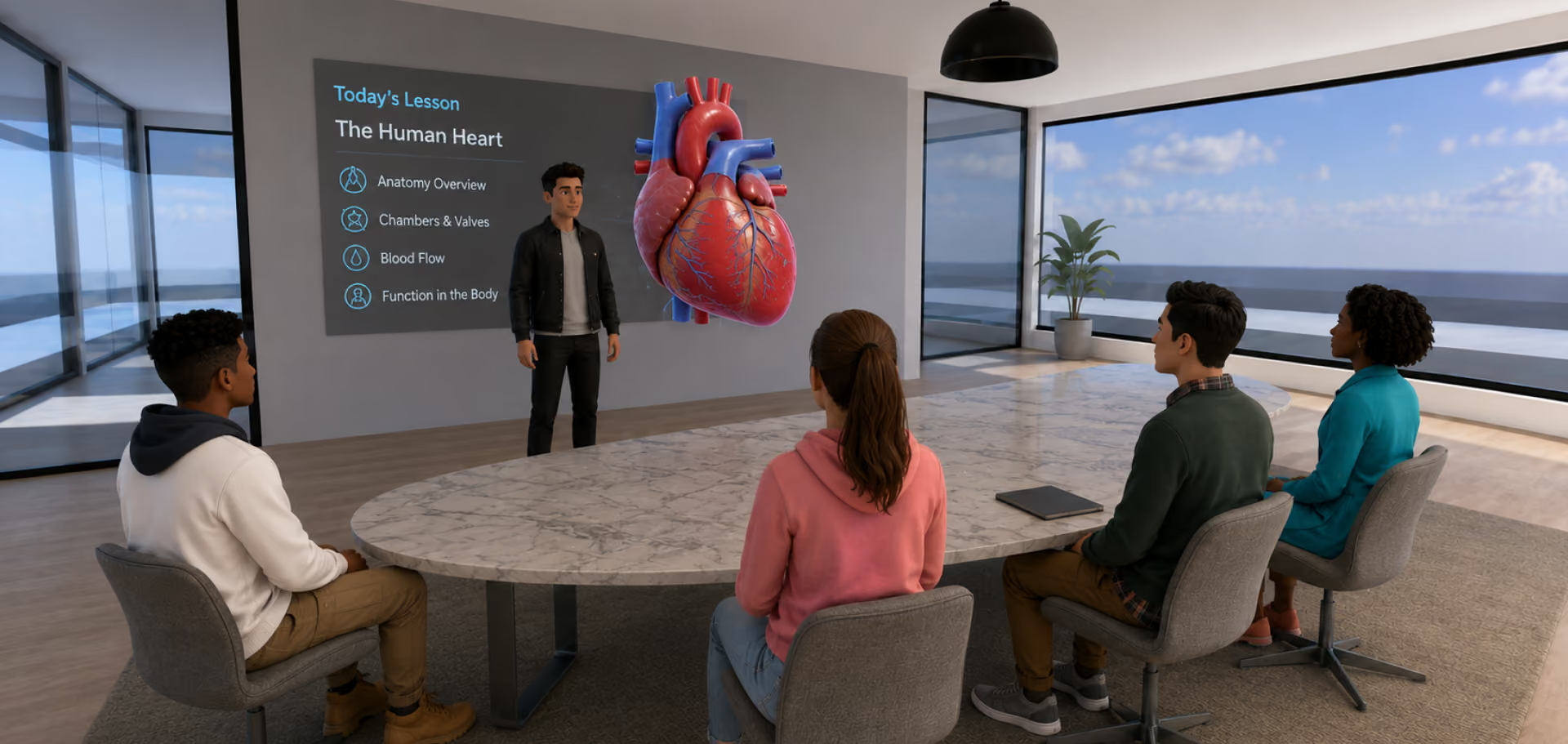
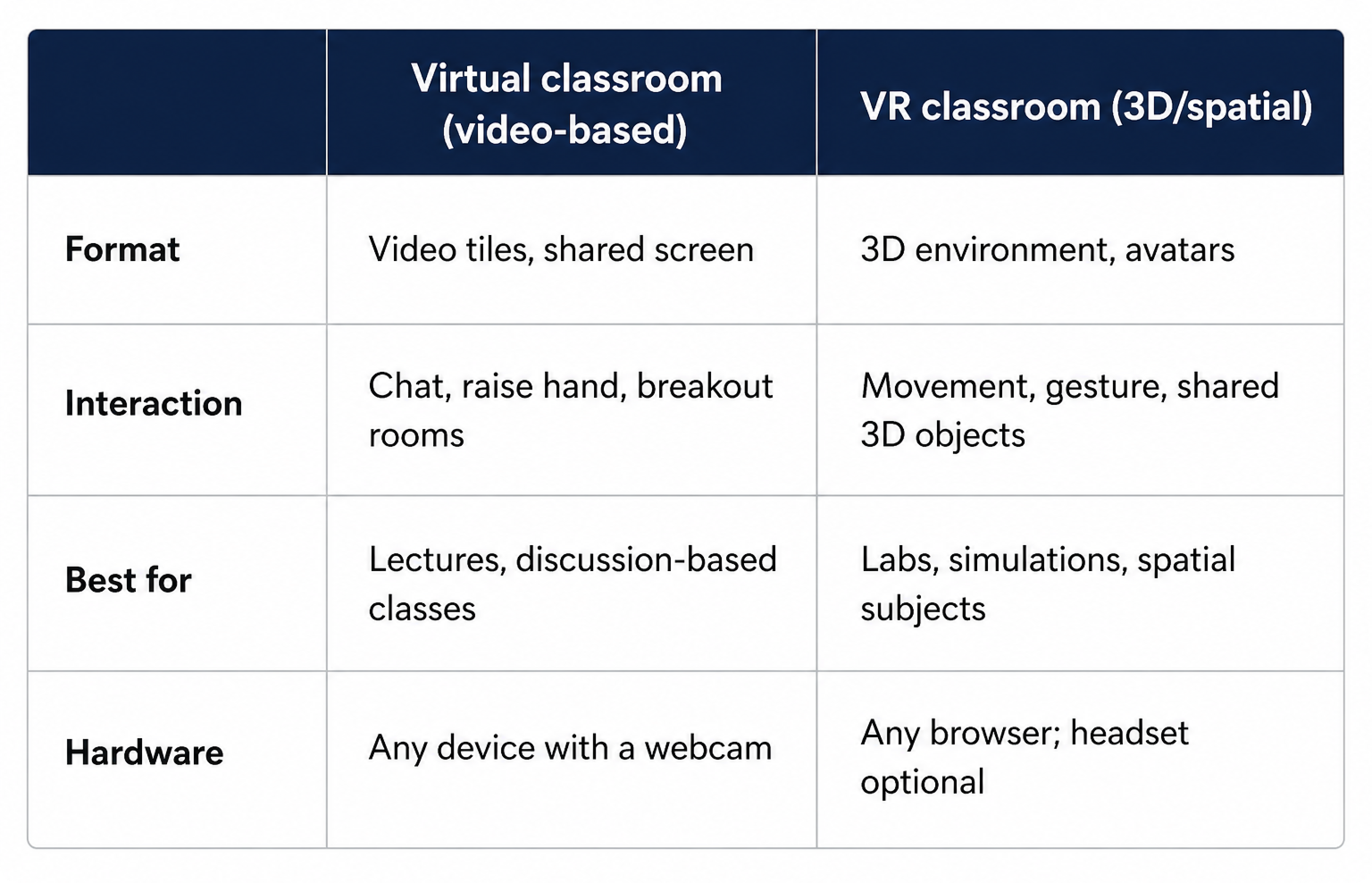
A virtual classroom is typically a video-conferencing tool — a call with shared screens and a chat window. A VR classroom is an interactive 3D environment where students and teachers exist as avatars in a shared space, able to move, gesture, and interact with 3D content together. Same goal — remote instruction — very different experience.
Most people searching "virtual classroom" are looking for the first thing. If you're evaluating options for genuinely immersive, spatial instruction, you want the second — and it's worth knowing the difference before you compare vendors.
Where the two tools diverge
When a VR classroom is worth the switch
A 3D classroom earns its extra setup when the subject benefits from spatial understanding — science labs where students manipulate models, historical or cultural immersion, engineering visualization, or any class where "seeing it from every angle" beats "watching a slide about it." For a standard lecture-and-discussion format, a video-based virtual classroom remains the simpler, sufficient tool.
Common questions
- Is a VR classroom the same as a virtual classroom? No. A virtual classroom is typically video-conferencing software for remote instruction. A VR classroom is a 3D environment where students and teachers appear as avatars and interact spatially — a different technology built for a different kind of lesson.
- Do students need a headset for a VR classroom? No, on browser-native platforms. Students join a 3D classroom from a laptop, tablet, or phone the same way they'd join a video call; a headset adds immersion but is never required to participate.
- What subjects benefit most from a VR classroom over a video call? Subjects with a spatial or hands-on component — science labs, engineering, anatomy, historical recreation, and language immersion — see the clearest benefit, because students can manipulate models and move through environments instead of watching a static screen share.
- Can a VR classroom replace a learning management system (LMS)? No — it complements one. A VR classroom is where spatial instruction happens; the LMS still handles enrollment, grading, and content organization. Most platforms support LMS embedding so the two work together rather than competing.
Related reading
See how this works on our virtual reality education platform page. You may also like Immersive Learning: The Complete Guide for Educators and VR in Education: Use Cases, ROI, and How to Get Started.
NRD's approach
See a working VR classroom built around your curriculum. Get a Demo or Build for Free